

How to boost out-of-home deliveries

While home is still a popular delivery location, the shift in delivery preferences continues in favor of out-of-home delivery. In 2025, 27% of European online shoppers chose parcel lockers, making them one of the most popular alternatives to home delivery.
The trend is clear – consumers are warming up to alternative delivery options more each year.
But what’s holding back faster adoption? And more importantly, how can delivery and e-commerce companies motivate people to pick out-of-home delivery more often?
Continue reading to find out.
Add OOH delivery to the checkout
This one is straightforward: if shoppers can choose only home delivery, they’ll never develop new habits.
OOH needs to be visible as an option, and shoppers must be able to see and choose nearby pickup points.
For online retailers, adding OOH options can mean fewer abandoned carts, higher first-attempt success rates, fewer customer service complaints, and customers who actually receive their parcels without hassle.
For delivery companies, getting your OOH network into more checkouts means better network utilization and all the cost savings that come with it.
From the technical side, this needs to be simple to set up. Look for plug-and-play widgets that integrate into any website without requiring development resources from either side.
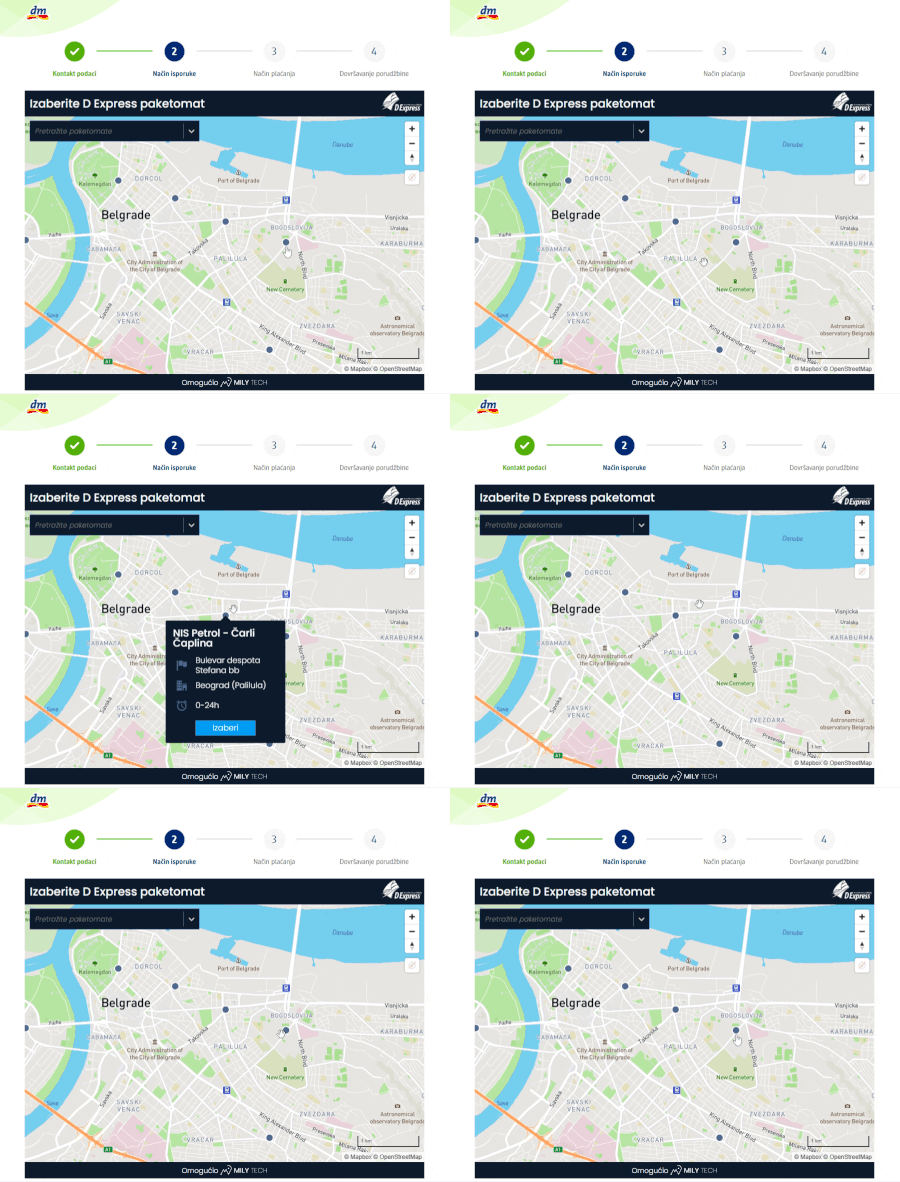
Highlight what matters to shoppers
Even if OOH is available as an option, shoppers might need a gentle push to try it.
The Active Last Mile Report from the Centre for London and the Behavioural Insights team tested this with over 3,000 London online shoppers. They split participants into four groups to test different approaches at checkout. The control group was shown standard options, while the others received nudges: a preselected OOH delivery option, environmental messaging, or convenience framing.
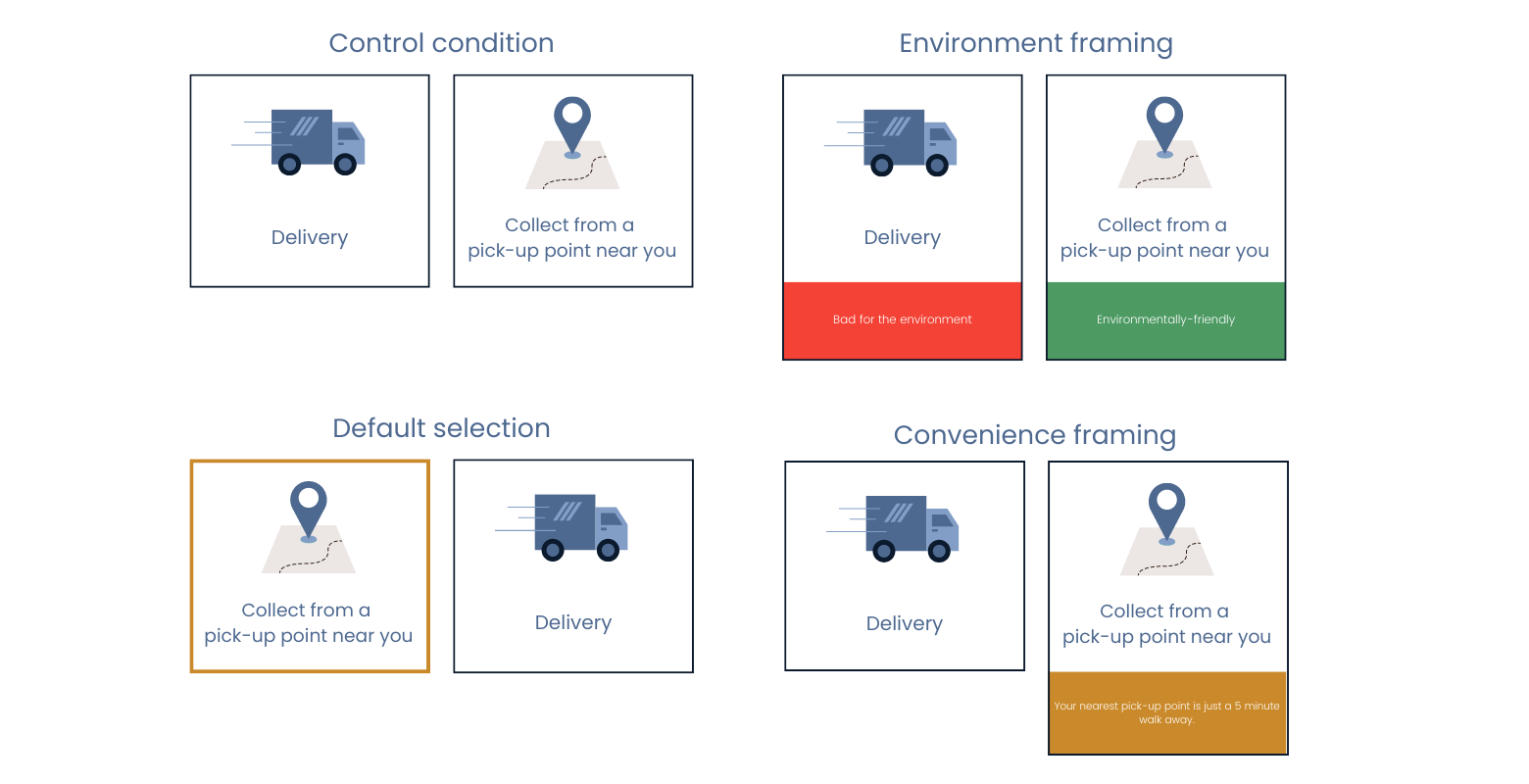
As a result, every nudge outperformed the control group. Environmental messaging was most effective, with 71% choosing OOH delivery. Convenienve messaging came close behind at 62%.
While the study has limitations, as OOH delivery was free and home delivery wasn’t, the takeaway holds: the right messaging encourages shoppers to choose OOH delivery.
There’s a growing appetite for this information. More than half of global shoppers want to know the environmental impact of their deliveries. The rise of secondhand shopping shows people are already making environmentally conscious choices, and they want their delivery options to align with those values too.
Make OOH delivery the cheaper option
When shopping online, 72% of consumers say free delivery would improve their experience. Costs matter, a lot.
Parcel and postal operators don’t necessarily need to make OOH delivery free, but it should be cheaper than home delivery. This is a viable option, as OOH delivery is generally more cost-efficient due to consolidated routes, fewer stops, and near-perfect first-attempt success rates.
Compare that to home delivery: failed deliveries mean re-attempts that nearly double vehicle time and operational costs.
If making OOH budget-friendly would encourage more people to choose it, it wouldn’t just be good for consumers – it would be good for your bottom line.
Optimize your OOH delivery network
If you’re facing low utilization, taking a look at how your network is performing and the data behind it can help you see where the issues are.
Get locations right
59% of shoppers would use a service point or locker if it were closer. And “closer” means really close. At most, people would go a kilometer out of their way.
This means you need to strategically plan locations so they’re along regular commute routes, easily accessible, and available 24/7 or at least open late. If your network isn’t being used, locations might be the reason why.
Understand why parcels don’t get delivered
Sometimes low utilization can be due to parcels being rejected or unable to be delivered.
A high number of rejected parcels is possible if the parcels are too large to fit into available parcel locker compartments. Reviewing parcel sizes and weights can indicate whether you need different locker configurations or need to expand some locations.
Or maybe it’s a capacity issue. Your driver shows up, and the locker or parcel shop is full. They’ve already made the trip and will now need to try delivering again at a later date. This ramps up the operational costs and is bad for customer experience. When planning the network, think about capacity and potential demand from the start. And if you’re currently experiencing capacity issues, identify which locations need additional capacity, such as a parcel locker outside a busy shop or mobile units.
See why deliveries take too long
Track how long parcels are waiting to be delivered and how many are in the queue. If it’s taking forever to deliver them, you’ve got either a process problem or a capacity issue. Try rerouting some deliveries to nearby points and notifying customers as a quick fix before digging into the root cause of the long queue.
Cut down dwell time with pickup incentives
Sometimes, utilization suffers because parcels sit at locations for too long. This often happens because customers aren’t in a rush to pick them up.
Shorter collection windows, like 48 hours or less, naturally reduce dwell time. If that feels too restrictive, try incentives instead. During peak seasons, many operators run promotions offering prize draws for quick pickups.
There is also an opportunity for delivery companies, online retailers, or partner locations to cross-promote. Quicker pickup could earn shoppers a discount at the gas station hosting your locker, or a gift card from the retailer.
The bottom line
Boosting OOH adoption is about getting several things right. The easiest way to start is by looking at your network data and asking the right questions.
Where is utilization low? What’s different between the worst and best performing pickup points? Is the issue in the location, or is it something hidden in the process or capacity?
The shift toward OOH is already happening. Parcel lockers and parcel shops are growing, shoppers are more open to alternatives, and sustainability matters more than it used to. The question is whether your network is ready to capture it.
Need help figuring out what’s working and what’s not for your OOH delivery network? Let’s talk.



.png)