Out-Of-Home Delivery
December 10, 2025

Build vs. Buy: Tools for planning and optimizing parcel locker networks

Build vs. Buy: Tools for planning and optimizing parcel locker networks

Parcel locker networks require strategic location decisions and continuous performance optimization. That puts parcel and postal operators in front of a key strategic choice: build custom software in-house or buy a specialized solution to plan and manage the network.

This guide walks through both options so you can decide what makes sense for your organization today and as your network scales.

You’ll find:

Quick comparison of when to build vs. buy

Criteria Build In-House Buy
Requirements Specific needs that generic tools don’t cover Needs largely match what specialized vendors already offer
Internal capabilities Strong engineering team and appetite to own the solution long term Core focus is not software; prefer to leverage vendor expertise
Timeline Longer planning and development timelines (>12 months) are acceptable Faster time-to-value matters; want to start using insights and optimization quickly
Costs Comfortable with significant upfront investment and ongoing maintenance Prefer predictable costs with vendor handling maintenance and improvements
Data & integration Ready to design integrations for internal tools and invest in data quality and governance Want a tool that integrates quickly with existing systems, with data handling built in

Building your own parcel locker analytics solution

When building in-house makes sense

Building software in-house allows you to create solutions that fit your specific workflows. You maintain control over features and development priorities, and can create custom integrations for proprietary systems. For last-mile companies with deep domain expertise and specific needs that other solutions may not address, this approach feels natural. 

The real cost and timeline of custom software

The real cost of “we’ll just build this” is usually higher and slower than teams expect.

Time to value

Before writing the first line of code, your team needs to validate the idea's feasibility, plan the architecture and features. For companies where software development isn't the core business, this phase alone can take 6 months. By the time you’ve tested and deployed the software solution, there is a great chance competitors have already secured premium locations. 

Development costs

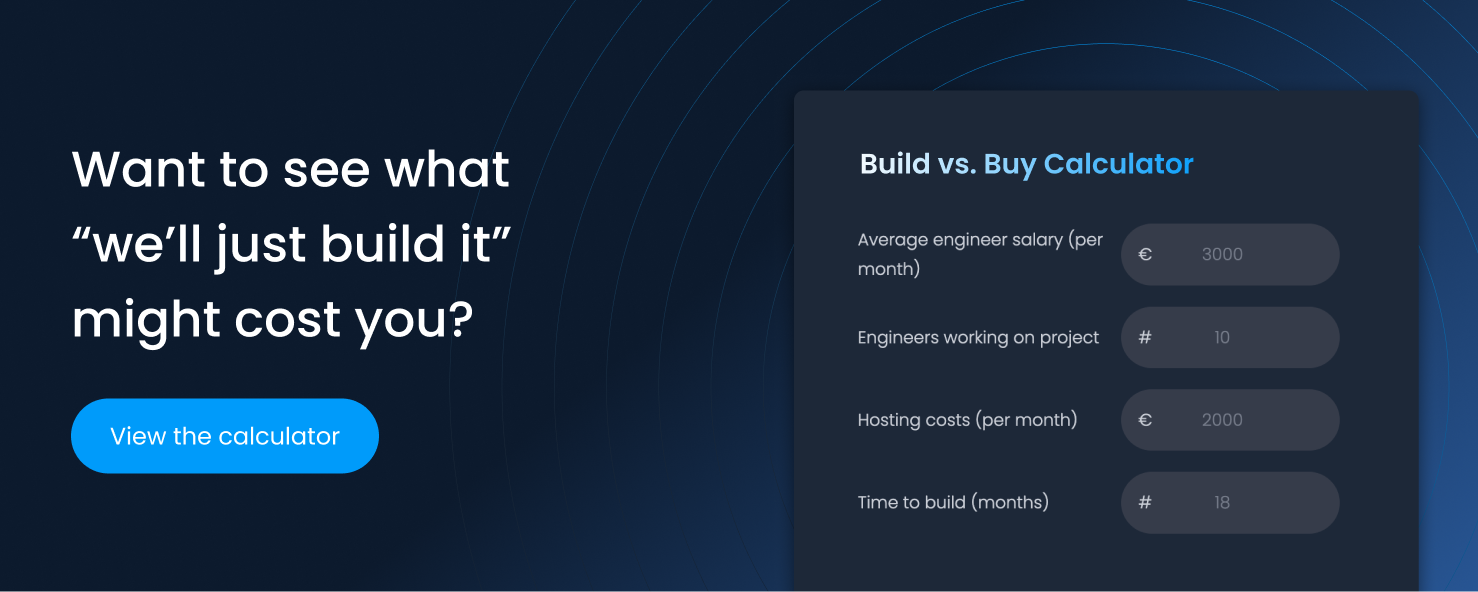
To build custom software, you’ll need a dedicated engineering team, a product manager, and an infrastructure and database hosting solution. 

Let’s say you assemble a team of 6 engineers at an average salary of €45,000 per year, who can deliver an initial version in 6 months. That works out to €3,750 per engineer per month. Add a conservative €3,000 per month for infrastructure and database hosting.

In an optimistic* 6-month scenario, you're looking at:

Engineering costs: 6 engineers × €3,750 × 6 months = €135,000
Hosting costs: €3,000 × 6 months = €18,000
Total costs for initial build: €153,000

*This assumes everything goes smoothly: no delays, no additional design or product management overhead, and engineers dedicated 100% to this project. In reality, most companies see 12–18-month timelines, which pushes the initial build costs into the €300–500K range.
Ongoing ownership

The total cost of ownership compounds beyond the initial build. While maintenance costs vary widely across studies, reflecting the software's complexity and other factors, a conservative estimate is that annual software maintenance costs typically range from 15 to 25% of the original development cost.

Add the opportunity cost of delayed network expansion during development, and you're looking at significant ongoing investment.

Overlooking data quality and volume

When dealing with poor data quality and massive data volumes, you need automated data audits and governance systems. Overlooking these systems and building solutions on low-quality data only creates more problems down the road –  accumulating technical debt and pulling resources away from the core business. 

What happens in practice - Tales from the industry

Disconnected systems

Large global operators often build multiple internal tools for different teams handling location scouting, performance monitoring, and operations optimization. Without integration between these tools, information gets siloed, and workflows become disconnected across departments and regions.


Simple dashboards as solutions

Some companies take a shortcut by building dashboards on top of existing Transportation Management Systems. These provide data visibility, but visibility alone rarely translates into actionable optimization recommendations or enables modelling scenarios. You can see what's happening, but you still don't know what to do next

Buying a parcel locker analytics platform

When buying off-the-shelf solutions makes sense

With off-the-shelf solutions, you get quicker access without spending months on development. The total cost of ownership is also lower because you won’t be responsible for maintenance, updates, or improvements. 

On top of that, you’re not just buying a software – you’re also tapping into the experience and the best practices of the team that’s built it, gained by working with people across the industry.

Evaluation criteria 

If buying sounds like a fit, use these criteria to compare vendors:

  • Industry-specific capabilities: Generic analytics tools lack specialized features for parcel locker networks, including location potential scoring, real-time utilization tracking, and network optimization recommendations. These aren't features you'll find in standard business intelligence platforms.
  • Integration: Speed and ease of integration determine how quickly you can get started. The right tool automatically pulls data from your systems and third-party sources (e.g., population, points of interest) to provide up-to-date access.
  • Testing: Introducing a new tool can feel like a risk, especially when decisions must be made during critical periods, such as peak seasons. Reputable vendors offer proof-of-concept projects and phased rollouts to minimize disruption and reduce uncertainty. 
  • Scalability: The tool you use needs to scale with your network, handling everything from 100 lockers to 10,000+ lockers, increasing data volumes, and multi-country operations. 
  • Learning curve - Consider who will actually be using the tool. Some organizations have dedicated GIS teams with the expertise to run complex spatial models, while others rely on sales or acquisition teams who may lack technical backgrounds. If your operations team can't use the tool effectively or share its outputs with the people who need them, the analysis won't deliver the value you need. The right solution should make it easy for everyone to run analysis, iterate quickly, and share results. 

If you’ve decided that buying a specialized platform is the right path, the next question is which solution can actually handle the realities of your network at scale.

How does OOH Delivery Analytics compare

Mily Tech’s OOH Delivery Analytics solution is a toolbox for building, managing, and scaling successful parcel locker networks. 

It combines data and automation to help parcel and postal operators roll out faster, optimize utilization, and de-risk network growth.

→ Explore success stories and see how our clients solve last-mile delivery challenges with Mily Tech

As a result, teams can achieve faster time-to-revenue from optimized locations, reduced resource misallocation, and data-driven decisions backed by industry expertise. You focus on core operations while we handle the analytics.

Still weighing up whether to build or buy? Reach out and see how OOH Delivery Analytics can help you reach your network goals faster.

Mily Tech uses the information you provide to contact you about relevant content, products, and services. You can unsubscribe at any time. For more information, please see our Privacy Policy.
Thank you for your interest!
The guide will open shortly.
Oops! Something went wrong while submitting the form.
Mily Tech uses the information you provide to contact you about relevant content, products, and services. You can unsubscribe at any time. For more information, please see our Privacy Policy.
Thank you for your interest!
The white paper will open shortly.
Oops! Something went wrong while submitting the form.
Mily Tech uses the information you provide to contact you about relevant content, products, and services. You can unsubscribe at any time. For more information, please see our Privacy Policy.
Thank you for your interest!
The white paper will open shortly.
Oops! Something went wrong while submitting the form.